Photoshopping Herodotus

March 6th, 2010 by stuartfreedman

Last week I read that a new biography of Ryszard Kapuscinski, the great Polish Foreign correspondent, had accused him of inventing a good deal of his work. The biographer, Artur Domoslavski, observes that Kapuscinski “consciously built on his status as a legend” and “extended the boundaries of reportage far into the realm of literature”. I read this in Delhi online and, somehow the process of reading these allegations on a computer screen made me smile with irony. It made me think just how far we think we’ve come in journalism and reporting but perhaps just how little we’ve progressed. Let me explain.

I have few heroes in photography, but I held people like Kapuscinski, like Chatwin and Lewis et al as great writers that I could read as much for pleasure as literal accuracy. I don’t read Polish and so the details of Domoslavski’s allegations are a little hard to substantiate but they are not new. There has been a great deal written about Kapuscinski in the last decade: how he was a spy, how he was a womaniser. Much of it to me smacks of a jealousy and a pettiness and the disturbing tendency in modern life to have an icon to smash. We live in a celebrity culture controlled by big business and advertisers that have a financial stake in selling things – people – as commodities. That requires constant banality and revision. This week, ‘failed celebrity actress recovers from drugs’. Next week, ‘failed celebrity actress caught having an affair’. Orwell called it Prolefeed. What all the commentators have failed to mention is that Kapuscinski, when not filing tight wire reports for the Polish news service, was working within the tradition of his own hero, Herodotus, whose books he kept close by for all of his career. Herodotus drew upon an earlier oral tradition of story-telling and interpreting the world from his travels. Sometimes, he wasn’t strictly accurate (‘dog headed men, gold digging ants and flying snakes’ spring to mind) but that wasn’t necessarily the point. The Histories are as much about him as they are the events that he describes: he was interpreting the world politically through the prism of the mid fifth century BC. Kapuscinski was writing during the Cold War and cleverly subverting his masters when he was able to by speaking directly of the warmth and humanity of those people that he met. We are all constructs of our position on time. Plutarch’s description of Herodotus’ work is vicious:

“He’s a dangerous Barbarian lover (a great heresy at the time) who praises foreigners and denigrates the most ’solemn and holy truths of Greek religion with Egyptian humbug and fairytale”.

and of course misses the point entirely. Kapuscinski, like Herodotus was evidently no saint – it may be that he polished quotes, ‘tidied’ sentences but I wonder if that mattered: he was writing what he called ‘literary reportage’. It’s a way of understanding the world – to be able to breathe others’ air – you’re meant to believe what you are being told, but not in every literal detail. What we know for certain is that the world has lost a great reporter and a great writer: a man that suffered terrible hardship and was a conduit for the story of the later half of the twentieth century through his travels.

Which brings me back to the title of this post. Last week a photographer, Stepan Rudik was disqualified from the World Press Photo competition for altering an image. Rudik photoshopped out an offending foot from a frame but he also savagely cropped the picture and converted it to black and white. To be fair,  it isn’t a million miles away from what Eugene Smith did with his Haiti pictures – except perhaps in intention. Smith was working in not a disimilar way to Kapuscinski – attempting to change the world by showing itself to itself (albeit with some literary license). Rudak was trying to win a prize which has somehow (and very sadly) become the defining element of a successful photojournalistic career. My contention here is not that Rudik was wrong or right (and I honestly feel rather sad for him) but that as photography and journalism stumbles further into the abyss of uncertainty and change, the move by the World Press jury looks a little like closing the stable door after the horse has bolted. As photography is neutered by loss of magazines, funding and status, the industry relies increasingly on young freelancers with digital cameras to cover the world. Cheaply. Perhaps it’s my age but I see an erosion of professional standards, ethics and training. As a young photographer I aspired to those in Magnum, Network, Rapho, Gamma etc: the business was difficult to break into and there were identifiable mentors. No longer. It’s a free for all. We’re all journalists now and as far as I can see, there’s an ocean of visual mediocrity masquerading as the best of photojournalism – heavy post-production, a snapshot aesthetic. Easy frames – boring frames. There’s an army of young photographers treating the Developing world as an extended gap year in which to launch their careers into a media that they have no understanding of. Wars in Iraq and Afghanistan have meant a generation covering war by treating ‘embedding’ as the norm.

Of course we get the industry that we deserve in a way. If we clamour for the pap of celebrity then we shouldn’t be surprised if journalistic standards fall. That’s why this is a defence of Kapuscinski. As a master storyteller he was entirely aware of what he was doing but had the intellectual rigour to understand the context that he was working within. It’s a lesson that photographers more than ever need to learn.

Orphan Works and the death of visual journalism

February 18th, 2010 by stuartfreedman

I write this during a rather frenetic period in Delhi where I seem to be working on several things at once. I thought I should mention, ironically from the land of bureaucracy, some developments in the UK -  the home of liberty. Allegedly.

As some of you may be aware, the British government is determined to push through a devastatingly stupid piece of legislation – primarily aimed to give the ailing publishing industry free content: photographers images. Despite the failure of Orphan Works Legislation in the USA last year, HMG will seea similar bill into UK law by March 2010.

I am too tired, too saddened and angry to discuss this fully here but it means essentially that any image on the web, uncredited, is fair game for anyone to use. Since there is little way of proving ownership apart from visibly watermarking one’s name across every visible image, it means that anyone can come and use my work however they please without payment. In one masterstroke the UK government has effectively killed the concept of copyright for visual creators (that has stood for 150 years) and overturned the idea of moral rights. So – if you have images on Flickr, Facebook, Google or whatever – you might have the privilege of seeing someone use them commercially at your expense and there will be little you can do about it. And before anybody thinks that their work is protected on these or any other sites, the onus will be on you to prove that your work has been taken. You can of course register your work. For a fee. Good luck with that.

More Kafka-esque and more worrying is the UK Government’s attempts to effectively ban photography in public places in the name of data protection. Essentially The Information Commissioner’s Office (ICO) has decided that professional photographers (amateurs with mobile phones will be exempt – for now) must now gain consent from anyone who might object to being photographed in public. This means the end to any kind of visual journalism/documentary/news work on the streets. Ironically, as this proposal is about protecting individual’s rights online and does not as I understand it specifically mention photography per se, I would venture that film cameras and images recorded as analogue would be exempted. Except of course they couldn’t be published electronically. For those inclined, you can read the consultation document here.

A fuller, more comprehensive survey of all this can be found at the excellent Copyright Action site to whom I am indebted for tireless service in highlighting these atrocious pieces of absurdity.

I would urge all to draft a letter to their MP’s (sorry if anyone heard a weary note in my voice there…) using this template. It’s not much, but short of me condoning more, ahem, forthright action against those seek that speak in our name I would suggest that this might be the only course…

http://copyrightaction.com/digital-economy-bill-mp-letter-template

Overexposed (?)

January 26th, 2010 by stuartfreedman

As I sit packing in Delhi waiting to go to the South on a story, a good friend, Martin Beddall emails me about a programme (‘Overexposed’) he was interviewed for on BBC Radio a while ago. Martin was a postgraduate student on the photojournalism course at the (then) London College of Printing nearly twenty years ago. Another former student, Miles Warde has retraced the fate of some former classmates. As the BBC has it:

“Miles Warde presents the story of a group of photojournalists who set out to witness world events. They went to Yugoslavia, Angola, Chechnya, Gaza and Iraq. Two of them were shot dead. A compelling portrait of youthful ambition and the power of photography to change the world”.

The programme, originally broadcast on Monday 25 Jan 2010 is available on BBC iPlayer for another week.

Listen here:

Although I wasn’t a student on the course, I was around the same time finding my feet and as I’ve written previously, was friends with and worked alongside two photographers, Paul Jenks and James Miller who were both subsequently killed.

An odd feeling listening: my friend Gary Calton is featured as well and his and Martin’s comments ring very true. As a generation we seemed to have wanted to change the world. Was it because we had come through the politics-stained 1970’s that were in turn coloured by the 1960’s? I don’t know but I sense something now has changed. The myth of the great days of the magazine photographer has been exposed. There are no great magazines left to run work: TV, video and now the internet has won. We live in a more cynical age and we are all a little older, if not a little wiser.Many of us are struggling to find a way to say the things that still need saying. Perhaps it will not be through photography.

And the world needs changing more than ever…

Perfect Pathshala

January 18th, 2010 by stuartfreedman

It’s rare these days that a jaded old photographer like me finds something positive about the industry but that is exactly what has happened in the last week in Chittagong in Bangladesh.
As you may remember, I was asked to lead a workshop for aspiring photojournalism students from Norway and Bangladesh on behalf of the Pathshala Institute
headed by the prolific Shahidul Alam. It was a rather daunting challenge. The only workshop that I’d ever attended was as a young photographer myself at the World Press Masterclass in 1998. I’ve had no formal photographic education and, despite giving a dozen or so lectures and talks over the years, I wasn’t confident that I could add much to these students education. I need not have worried. Ably assisted by the extraordinary Abir Abdullah, an exceptional educator in his own right, I think – I hope – that I managed to pass on something of the little I know to the students.

I must say that the Norwegians were for their age, exceptional visual journalists and it was a lesson for me to see them produce their assignments with an energy and proficiency that would put many established UK professionals to shame. I think to a person their level of visual literacy was far higher than I was expecting. The Bangladeshi’s, some a product of the Pathshala Institute and some having just completed a basic photography course struggled a little with the idea of storytelling – the theme of the workshop. That said, their determination and enthusiasm was a pleasure to witness. I felt by the end that the concept of a photo-essay was firmly entrenched. As a matter of fact, despite some rather cliched ideas of what a documentary project could look like, it was a two Bangladeshi students – both women I should add – that produced ideas for their course projects that impressed me most. Both decided to work on the personal sphere. In an industry dominated by men and seemingly endless stories of poverty and darkness it was a welcome change.

It was also my first visit to Bangladesh – a pleasant journey from the cold English winter and Chittagong and it’s people in particular I have to thank for being so welcoming and open. I’m now due to come back in the summer to shoot a story. I’m looking forward to it already.

Delhi waits for me now – a flight from Dhaka and then almost a month in India. I have a corporate assignment there and then two stories that I need to work on.

As usual I shall be on:

0091 9810941435

It just remains for me to say thank you in particular to Abir, Shoeb and his wife (what a lovely meal), Joseph Rozario (a marvel), Ashraf (for all his patience with me), Shadab (for his kindness) and to the students – firstly for their beautiful and unexpected gifts (you know who you are…) and secondly for their patience and unwavering attention even when I’m sure I was talking rubbish… you all touched me deeply. I hope we stay in touch. Thank you.

For now I leave you with some images from the workshop and one of a couple of frames that I had time to make myself in Chittagong.

Bangladesh - Chittagong - Abir Abdullah talking to students (and myself) during the workshop

Bangladesh - Chittagong - Abir Abdullah talking to students (and myself) during the workshop

Bangladesh - Chittagong - Stuart Freedman works with Maria on her project ©Adnan Wahid

Bangladesh - Chittagong - Stuart Freedman works with Maria on her project ©Adnan Wahid

Bangladesh - Chittagong - Abir, Stuart and Shoeb address the class ©Adnam Wahid

Bangladesh - Chittagong - Abir, Stuart and Shoeb address the class ©Adnam Wahid

Bangladesh - Chittagong - Stuart Freedman addresses the class ©Marius Knutsen

Bangladesh - Chittagong - Stuart Freedman addresses the class ©Marius Knutsen

Bangladesh - Chittagong - A man dismantles a boat with a blow torch and hammer on the banks of the Karnaphuli River beneath the Kalurghat Bridge, Chittagong, Bangladesh

Bangladesh - Chittagong - A man dismantles a boat with a blow torch and hammer on the banks of the Karnaphuli River beneath the Kalurghat Bridge, Chittagong, Bangladesh

Protest and Survive

January 7th, 2010 by stuartfreedman

I urge everyone to attend a mass photo gathering in defence of street photography on January 23rd at Midday in Trafalgar Square organised by the pressure group I’m a Photographer not a Terrorist.

As their website eloquently states:

Photography is under attack. Across the country it that seems anyone with a camera is being targeted as a potential terrorist, whether amateur or professional, whether landscape, architectural or street photographer.

Not only is it corrosive of press freedom but creation of the collective visual history of our country is extinguished by anti-terrorist legislation designed to protect the heritage it prevents us recording.

This campaign is for everyone who values visual imagery, not just photographers.

We must work together now to stop this before photography becomes a part of history rather than a way of recording it.

trsq-poster-212x300

Images are funny things though and far be it from me to suggest that our rights are being eroded on a day to day basis by those that seek to make our lives more secure… but here are just a few recent developments to may be of interest:

The Children’s Secretary sets out £400m plan to put 20000 problem families under 24-hour CCTV supervision in their own homes

CCTV Cameras fitted in homes to spy on neighbours

Pubs ordered to close because of lack on CCTV

Talking TV cameras in London

But it’s OK because soon, the State will be able to ’spy’ on every ‘phone call or web search anyway

And let’s not forget that private security operators can join in the fun too

It’s all for your own good. Welcome to the future…

A peaceful New Year

December 31st, 2009 by stuartfreedman

As I was late in posting a Christmas message (I feel like the Queen…) I thought I’d better put something up as late as possible on the last day of 2009.

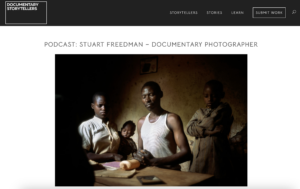
I seem to have lots of pictures of people dancing and partying across the world but when I thought about it, one image of hope and joy seemed to stick in my mind. The image below show a mother reunited with her son who had been kidnapped and forced to fight for Joseph Kony’s Lords Resistance Army in Northern Uganda. He’d been in the bush for a couple of years as I remember and I was present in an airless, dusty hut when he was delivered home by the Ugandan Army. His mother, completely surprised by her son’s miraculous appearance (she thought him dead) was overcome with joy and started to pray just after I took this image. I’ve often wondered what happened to him.

Happy New Year.

Peace.

Uganda - Gulu - A young man with obvious trauma is reunited with his mother and sisters after almost two years in the bush fighting with the Lords Resistance Army

Uganda - Gulu - A young man with obvious trauma is reunited with his mother and sisters after almost two years in the bush fighting with the Lords Resistance Army

A (late) Christmas post

December 28th, 2009 by stuartfreedman

As I slowly melt into the armchair under the weight and fug of too much food, alcohol and bad television I wondered what I could post that had some flavour of Christmas, image-wise… Seeing as I’ve never shot a Christmas story or stock at this time of year, I’m struggling a bit. I have come up with an old story I made in Northern Lebanon in 1998 about the work of Khalil Gibran, author of the Prophet. I travelled to B’sharre, then under the de facto control of the Syrian army of occupation and worked on a piece that illustrated the themes of Gibran’s poetry. Here are some pictures.

Lebanon - B'charre - A effigy of Christ in a coffin in a Maronite church in Khalil Gibran's birthplace in Northern Lebanon

Lebanon - B'charre - A effigy of Christ in a coffin in a Maronite church in Khalil Gibran's birthplace in Northern Lebanon

Lebanon - B'charre - A crucifix painted on a wall in the snow in Khalil Gibran's birthplace, B'charre, Northern Lebanon. The area is occupied by Syrian troops and so the indigenous population paint crucifixes as a symbol of opposition

Lebanon - B'charre - A crucifix painted on a wall in the snow in Khalil Gibran's birthplace, B'charre, Northern Lebanon. The area is occupied by Syrian troops and so the indigenous population paint crucifixes as a symbol of opposition

Lebanon - B'charre - A mysteriously empty coffin in a graveyard in Khalil Gibran's birthplace, B'charre, Northern Lebanon.."... do not grieve for me... I am gone from this place...". Gibran

Lebanon - B'charre - A mysteriously empty coffin in a graveyard in Khalil Gibran's birthplace, B'charre, Northern Lebanon.."... do not grieve for me... I am gone from this place...". Gibran

Lebanon - B'charre - An elderly Maronite Christian couple leave church in Khalil Gibran's birthplace, B'charre, Northern Lebanon

Lebanon - B'charre - An elderly Maronite Christian couple leave church in Khalil Gibran's birthplace, B'charre, Northern Lebanon

Lebanon - B'charre - Dying flowers on a tomb in Khalil Gibran's birthplace, B'charre, Northern Lebanon

Lebanon - B'charre - Dying flowers on a tomb in Khalil Gibran's birthplace, B'charre, Northern Lebanon

Lebanon - B'charre - A shepherd and his flock of sheep and goats near Khalil Gibran's birthplace, B'charre, Northern Lebanon..  ..." And He put His hand upon my shoulder and said, "From this day you shall love this sheep more than any other in your flock, for she was lost and now she is found"...Gibran

Lebanon - B'charre - A shepherd and his flock of sheep and goats near Khalil Gibran's birthplace, B'charre, Northern Lebanon.. ..." And He put His hand upon my shoulder and said, "From this day you shall love this sheep more than any other in your flock, for she was lost and now she is found"...Gibran

Lebanon - B'charre - A cross stands on a hillside in the Quadisha Valley near Khalil Gibran's birthplace, B'charre, Northern Lebanon. The Valley was the last refuge of the Maronire Christian hermits after the Islamic (Arab) invasions.

Lebanon - B'charre - A cross stands on a hillside in the Quadisha Valley near Khalil Gibran's birthplace, B'charre, Northern Lebanon. The Valley was the last refuge of the Maronire Christian hermits after the Islamic (Arab) invasions.

Pathshala Workshop and “light to show off the bride in”

December 14th, 2009 by stuartfreedman

In Bangla literature, the late afternoon light is apparently known as “kone dekhano alo” – “light to show off the bride in”. As someone who’s a bore fascinated with the quality of light, I thought that this was so lovely that I should mention it. That, and the fact that I’m going to lead a Photojournalism workshop in Chittagong, Bangladesh hosted by the Pathshala Institute of Photography. It’s a generous invitation by the prolific Shahidul Alam of Drik Picture Agency fame.

I’m teaching twenty eight students, between the 11th and 17th of January. The participating students will be from Oslo University College, Pathshala students and local students from Chittagong.

I will be on email and My Bangladesh cell will be: 0088-01711-127463. I plan to be in the region for an extra two weeks if anyone needs anything.

India’s ‘private’ parks

December 11th, 2009 by stuartfreedman

It’s with some relief that I read today in the Times of India that proposals to institute identity cards and entry fees to Bangalore parks have been scrapped.

The extraordinary idea, the brainchild of Horticulture Minister, Umesh Katti was to restrict entry to two of the ‘Garden City’s’ finest public spaces, Lalbagh and Cubbon Park to those that could afford, as he put it, the ‘paltry sum’ of Rs.200/-”. Further, identity cards would only be issued to those that had been ‘vetted’ over security concerns.

Lalbagh (Red Garden) is around two hundred and fifty years old. Cubbon Park, a British creation, is a century old. Both are a counterweight to the modernist, business friendly theme park that are the suburbs of modern Bangalore. Like most Indian parks they are populated by walkers, joggers, lovers, hawkers and the poor, sometimes untidily sleeping where they can. Oh, and Bangalore has a Laughter Club (a very Indian get-together where people laugh in groups to improve their health). Subversives all. Dangerous, anti-social elements that need checking and vetting and searching.

The case is interesting as it touches something that I have been photographing in Delhi for a while – Indian public space. Because cities are so crowded, public spaces become part of the personal, private sphere – a microcosm of Indian society. India has a profound love of gardens and greenery. I have written previously that all the major religions of this country have in some part a great reverence of nature – whether the gardens of the Mughals or the significance of the Bodhi tree for Buddhists or the garlanded offerings of Hindus. To privatise such public spaces for spurious ’security concerns’ seems to me to be a very profound political statement. As Bhargavi Rao and Leo Saldanha of the local ‘Environment Support Group’ said. “It is an effort to showcase Bangalore as an elite, investment-friendly city where public spaces are out of bounds for local residents, especially the poor.”

Arundhati Roy has recently commented that,

“… the era of the Free Market has led to the most successful secessionist struggle ever waged in India – the secession of the middle and upper classes to a country of their own… where they merge with the rest of the world’s elite”.

The poor and those that don’t quite fit into a corporate strategy are an untidy blemish and need to be excluded.

In fact it is entirely analogous to what is happening in much of the Western (well, read the US and the UK) world. Britain is the most spied-on country in the world in terms of CCTV and legislation passed over the last twelve years has meant that fundamental freedoms that we took for granted – like being able to photograph in public where we pleased – are no longer guaranteed. Extensions to pre-charge detention means that suspects in the UK can expect to be detained for periods exceeding those of other comparable democracies. As Simon Jenkins wrote in the Guardian yesterday, since 1997, the UK government has created more than 3000 new offences. 1,472 at the last count were imprisonable. You can be jailed for not having a licence for a church concert, smoking in a public place, selling a grey squirrel, trans-shipping unlicensed fish, or disobeying a health and safety inspector. All underpinned by a profit motive for private companies who have interests in surveillance, security operatives and prisons. If we make citizens afraid of each other they will be more pliable: I know photographers in the UK that have admitted to self-censoring in public. Taking pictures of children, of property, of the police are now likely to lead to confrontation with authority. A company has already found a way to ‘monetise’ this by paying ordinary people to watch CCTV footage and report anything ’suspicious’.

Section 44 of the Terrorism Act in the UK no longer requires authorities to have reasonable suspicion to search people for such subversive activities as photographing on the streets. We are all suspects that have to be monitored. All the time. For our own good. Usually by private security. For profit.

Soon there will be nothing public left of all our public spaces.

India - New Delhi - a bench in the early morning mist in Nehru Park

India - New Delhi - a bench in the early morning mist in Nehru Park

India - New Delhi - A yoga class in Lodi Gardens in front of the Bara Gumbad Tomb

India - New Delhi - A yoga class in Lodi Gardens in front of the Bara Gumbad Tomb

India - New Delhi - A couple in the grounds of the Purana Qila, New Delhi, India. Such parks are often the only place where young lovers can meet away from their parents and families

India - New Delhi - A couple in the grounds of the Purana Qila, New Delhi, India. Such parks are often the only place where young lovers can meet away from their parents and families

India - New Delhi - Men play cards on a traffic island in New Delhi, India whilst one of their friends sleep. The traffic islands in the centre of the city often have manicured lawns and are well cared for. Many people sleep here at night but in the daytime they are used as small parks by workers

India - New Delhi - Men play cards on a traffic island in New Delhi, India whilst one of their friends sleep. The traffic islands in the centre of the city often have manicured lawns and are well cared for. Many people sleep here at night but in the daytime they are used as small parks by workers

UK - Cirencester - A private Security Guard examines the licence plate of a vehicle outside a Gated Community,

UK - Cirencester - A private Security Guard examines the licence plate of a vehicle outside a Gated Community,

UK - London - A Private Security Operative patrols South London council estate

UK - London - A Private Security Operative patrols South London council estate

India’s other filthy river

December 4th, 2009 by stuartfreedman

I read yesterday that the World Bank is to lend India $1bn to clean up the Ganges River. The Ganges is one of the world’s most polluted waterways and supports perhaps 400 million people. Despite earlier government promises to make its water drinkable by 1989, it flows with industrial effluence and sewerage. As I wrote previously, a solution to the water crisis is crucial to India’s survival and as Sunita Narain (and others) have argued it needs an Indian solution.

I’ve been lucky enough to have been touched by the magic of this river often over the years. I’ve covered two Kumbh Melas (the enormous religious bathing pilgrimage that takes place four times every twelve years at the confluence of the Ganges and the Yamuna) and visited the extraordinary Varanasi many times. There is something touching, real and honourable about Indian’s reverence and awe at the Ganges; something that speaks about life and its transitory nature. It’s a beautiful thing to see villagers come hundreds of miles just to bathe in the river and feel its coolness at dawn as they submerge themselves. Humbling and puzzling to see the processions of corpse bearers literally running to the cremation grounds on the ghats in Varanasi to burn a body. I shall never forget my first sight of a body (suicides, children and snake bite victims are swallowed by the river whole) bloated, rolling and turning in the gentle waves of my boat one morning at dawn.

Some pictures:

India - Varanasi - A man makes an offering to the Ganges at dawn

India - Varanasi - A man makes an offering to the Ganges at dawn

India - Varanasi - A worker at the Burning or 'Manikarnika' Ghat tends a cremation fire. The men are all from the same low caste called Dons - Dalit's or 'untouchable's' rendered ritually unclean by their work

India - Varanasi - A worker at the Burning or 'Manikarnika' Ghat tends a cremation pyre. The men are all from the same low caste called Dons - Dalit's or 'untouchable's' rendered ritually unclean by their work

India - Allahbad - Pilgrims cross one of the many pontoon bridges erected at the Kumbh Mela

India - Allahbad - Pilgrims cross one of the many pontoon bridges erected at the Kumbh Mela

India - Allahabad - Saddhus dry themselves after a ritual bath at the Kumbh Mela

India - Allahabad - Saddhus dry themselves after a ritual bath at the Kumbh Mela

India - Allahabad - Pilgrims ritually bathe at the Ardh Kumbh Mela

India - Allahabad - Pilgrims ritually bathe at the Ardh Kumbh Mela

India - Allahabad - Saddhus in a boat at the Kumbh Mela

India - Allahabad - Saddhus in a boat at the Kumbh Mela

India - Allahabad - A pilgrim and his wife get ready to immerse themselves in the Ganges as an act of religious purification

India - Allahabad - A pilgrim and his wife get ready to immerse themselves in the Ganges as an act of religious purification